MLI
← Back to News
MilestoneMar 10, 2026

Computational Modeling of Failure at the Fabric Weave Level in Reentry Parachute Energy Modulators

Computational Modeling of Failure at the Fabric Weave Level in Reentry Parachute Energy Modulators
Image source: NASA
References
Story Brief

Download PDF: Computational Modeling of Failure at the Fabric Weave Level in Reentry Parachute Energy Modulators.

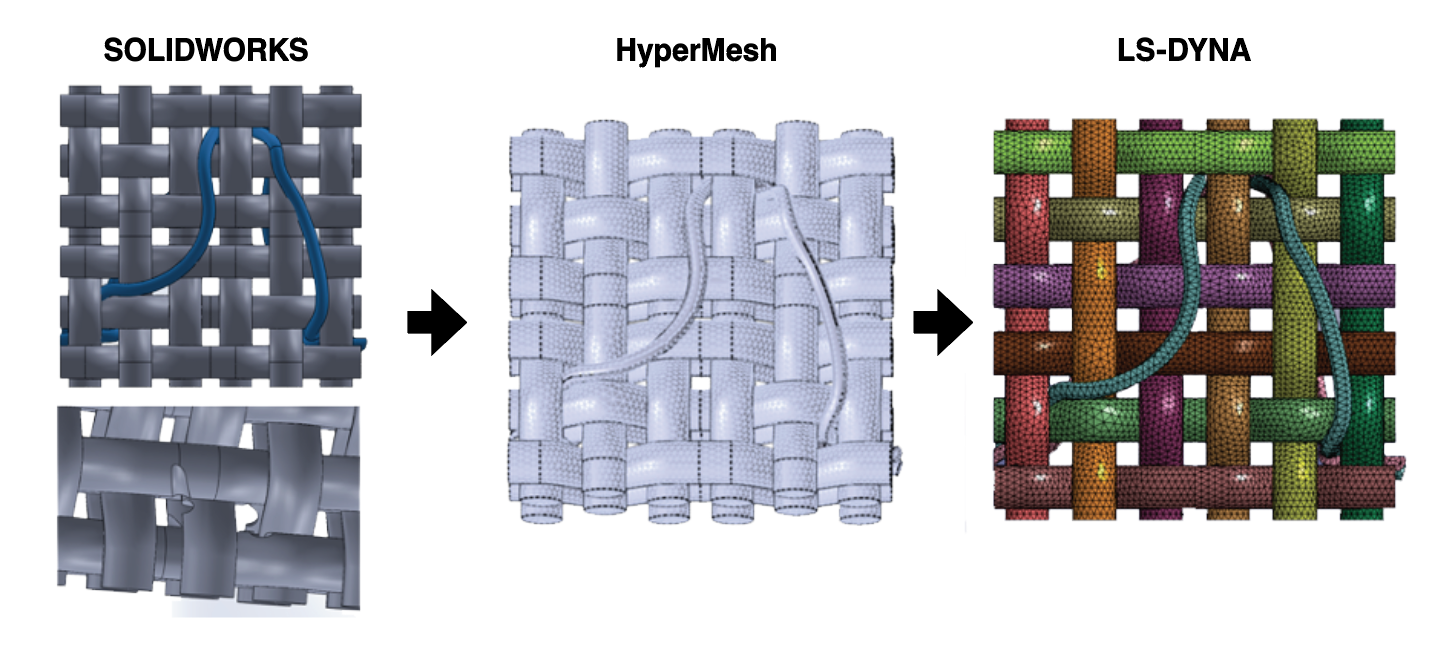
Energy modulators (EM) are textile mechanical devices designed to dissipate snatch loads that occur when parachutes are deployed. Although critical for mitigating shock loads, recent flight testing has shown increasing variability in EM behavior, raising concerns about their performance predictability and potential failure under dynamic loading conditions. In response, a novel approach was implemented to create a computational model of an EM at the fabric weave level using the simulation software, LS-DYNA.

EMs typically consist of a long strip of structural Kevlar webbing that is folded and stitched together with a nylon zigzag stitching pattern to form an EM "ear. " As an EM is pulled above a threshold load during deployment, the nylon stitching rips, unfolding the EM and dissipating shock forces. This process is illustrated in Figure 1, exemplifying stages of EM extension during stroking.
Reference Details
Mentioned Companies & Entities