NASA Webb, Hubble Share Most Comprehensive View of Saturn to Date
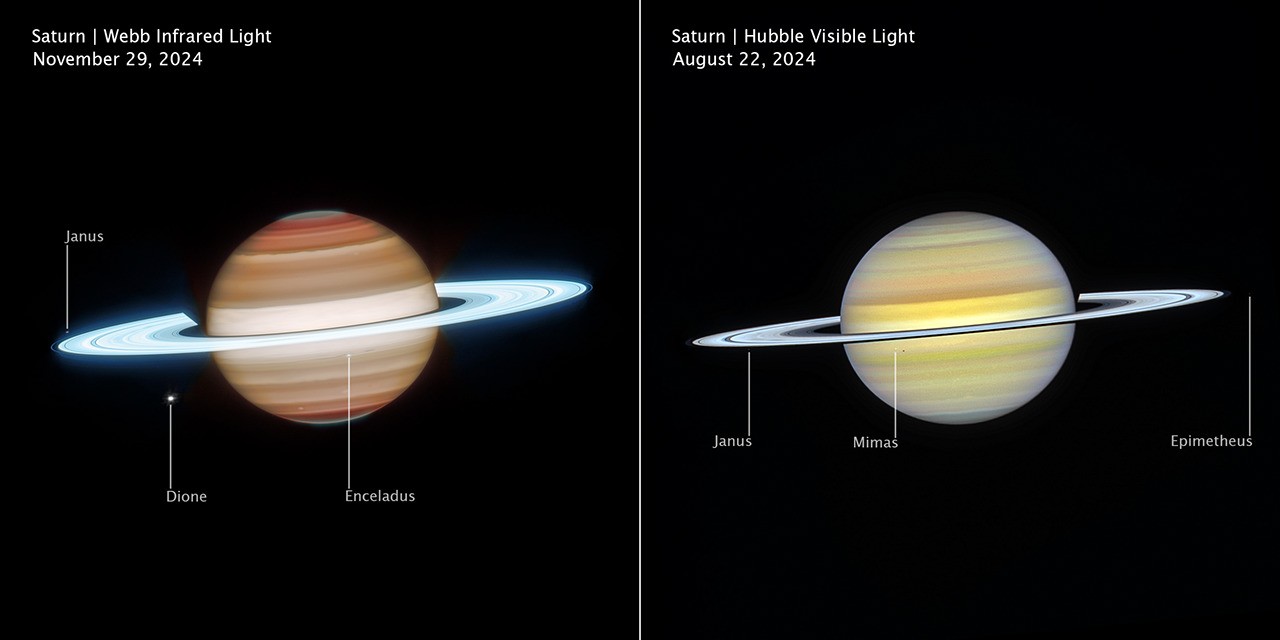
NASA's James Webb Space Telescope and Hubble Space Telescope have teamed up to capture new views of Saturn, revealing the planet in strikingly different ways. Observing in complementary wavelengths of light, the two space observatories provide scientists with a richer, more layered understanding of the gas giant's atmosphere.
Together, scientists can effectively 'slice' through Saturn's atmosphere at multiple altitudes, like peeling back the layers of an onion.
Several of the pointed edges of Saturn's iconic hexagon-shaped jet stream at its north pole, discovered by NASA's Voyager spacecraft in 1981, are also faintly visible in both images. It remains one of the solar system's most intriguing weather patterns. Its persistence over decades highlights the stability of certain large-scale atmospheric processes on giant planets.