SPARCS CubeSat ‘First Light’ Images
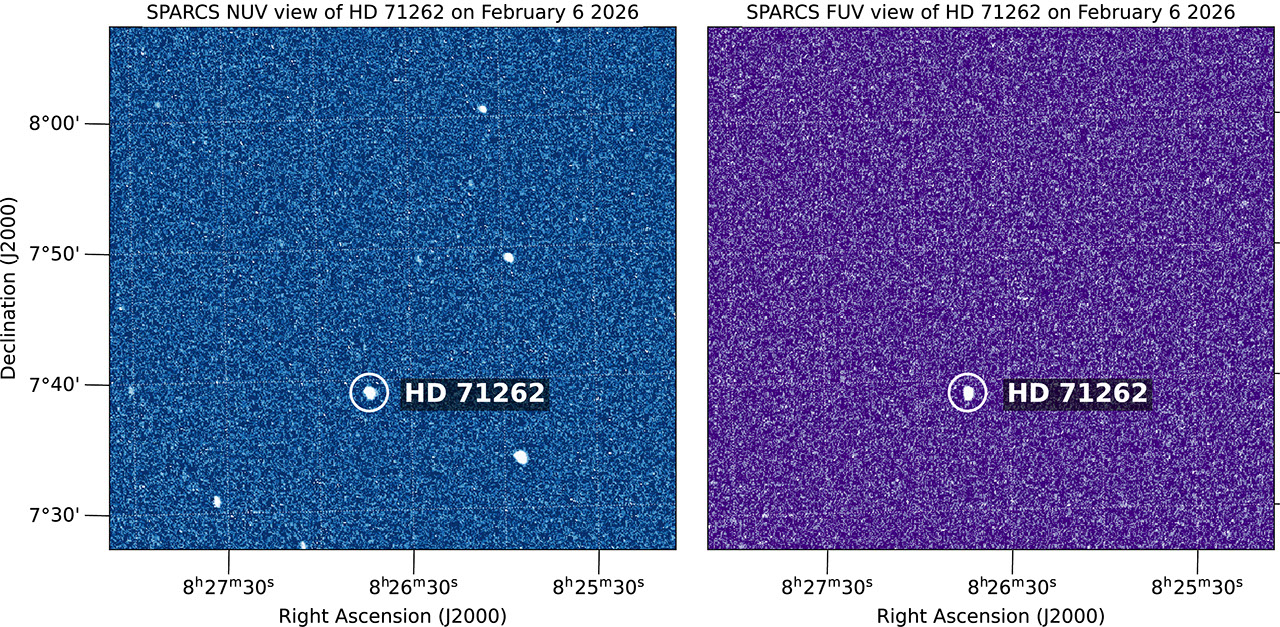
This pair of images shows stars observed by the SPARCS (Star-Planet Activity Research CubeSat) space telescope simultaneously in the near-ultraviolet, left, and far-ultraviolet, right. These observations were recorded on Feb. 6, 2026, three weeks after the cube satellite, or CubeSat, launched aboard a SpaceX Falcon 9 on Jan.
Roughly the size of a large cereal box, SPARCS will monitor flares and sunspot activity on low-mass stars — objects only 30% to 50% the mass of the Sun.
The SPARCS spacecraft is the first dedicated to continuously and simultaneously monitoring the far-ultraviolet and near-ultraviolet radiation from low-mass stars. Over its one-year mission, SPARCS will target approximately 20 low-mass stars and observe them over durations of five to 45 days.