Tiny NASA Spacecraft Delivers Exoplanet Mission’s First Images
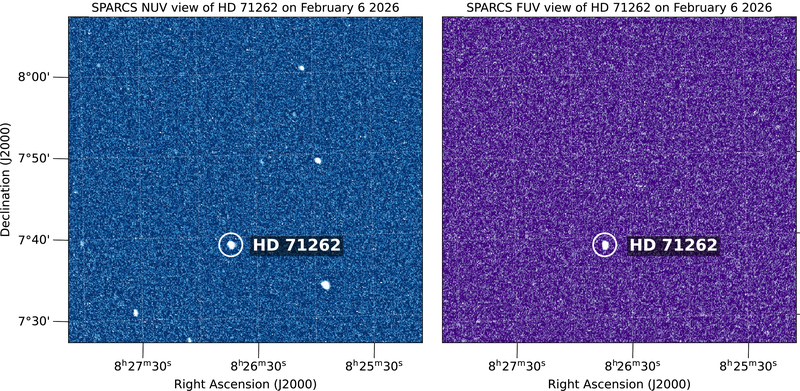
This pair of images shows stars observed Feb. 6, 2026, by the SPARCS space telescope simultaneously in the near-ultraviolet, left, and far-ultraviolet, right. The fact that one star is seen in the far-UV while multiple are seen in near-UV offers insights into the temperatures of these stars, with the one visible in both colors being the hottest.
The SPARCS cube satellite is ready to begin studying low-mass stars and to reveal details about the habitability of the planets they host.
With the first images from the spacecraft now in hand, the team behind NASA's Star-Planet Activity Research CubeSat, or SPARCS, is ready to begin charting the energetic lives of the galaxy's most common stars to help answer one of humanity's most profound questions: Which distant worlds beyond our solar system might be habitable?