How Massive Star Clusters Shape Galaxy Evolution
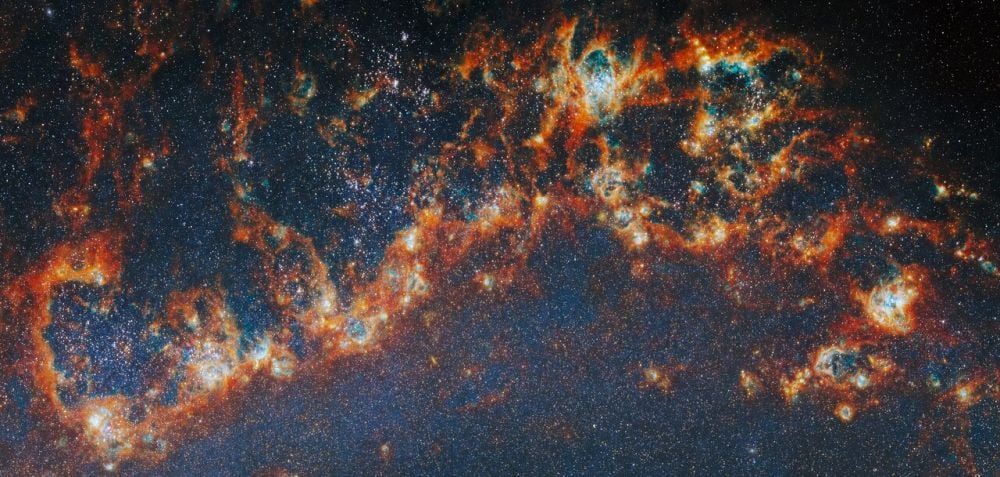
A team of researchers used the NASA/ESA/CSA James Webb Space Telescope together with the NASA/ESA Hubble Space Telescope to observe almost 9,000 star clusters in four nearby galaxies. They studied younger clusters that were still embedded in their natal gas clouds, and older ones that had dissipated that gas. Their results show that more massive star clusters emerge more quickly from their birth, clearing away gas and filling the galaxy with ultraviolet light. The research presents a better understanding of star formation in galaxies, something lacking in scientific simulations, as well as how and where planets can form.
A team of researchers used the NASA/ESA/CSA James Webb Space Telescope together with the NASA/ESA Hubble Space Telescope to observe almost 9,000 star clusters in four nearby galaxies.
A team of researchers used the NASA/ESA/CSA James Webb Space Telescope together with the NASA/ESA Hubble Space Telescope to observe almost 9,000 star clusters in four nearby galaxi.