It's Not Supposed To Be Like This: A Giant Planet Orbits A Small Star
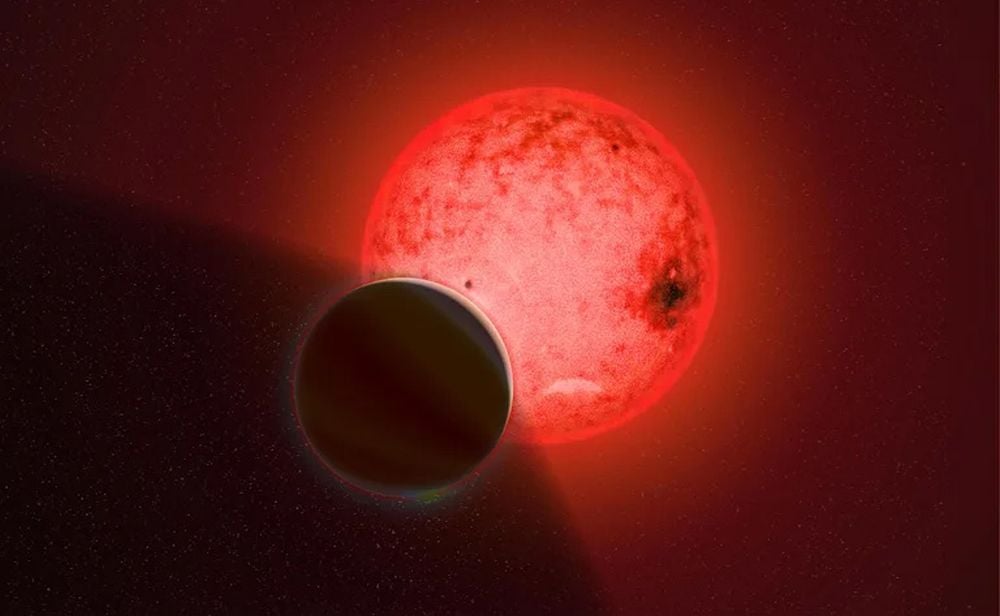
The nebular hypothesis states that stars and the planets that orbit them form from the same reservoir of material, called a solar nebula. It's the most commonly accepted explanation for how solar systems form. But despite its ability to explain many things about solar system formation, there are some outstanding questions.
The study of exoplanets and their stars poses a challenge for the nebular hypothesis. Planet-hunters have found massive gas giants as large as Jupiter—and even larger—orbiting very close to their low-mass stars. Some of these planets are closer to their small stars than Mercury is to the Sun.
Now many of the same researchers have revisited TOI-5205b. They're leading a JWST observation program aimed at exoplanets like TOI-5205b called GEMS: Giant Exoplanets around M dwarf Stars. GEMS uses the JWST to study the atmospheres of these planets, and TOI-5205b is a prime target because its transit in front of its star is so deep.